Filing a hail claim is not free, even if the carrier pays. Your home insurance CLUE report (Comprehensive Loss Underwriting Exchange, run by LexisNexis) records every claim and inquiry on your house for up to 7 years, and every carrier pulls it before renewing or quoting you. Two claims is a yellow flag. Three claims in five years is the community-consensus threshold for non-renewal at most major carriers. A Chicago homeowner on r/Insurance learned this after his roofing contractor friend talked him into filing twice in two years and nearly got him dropped on the third. Before you call the claims line, do four things: pull your CLUE report, read your declarations page, run the deductible math, and decide whether the claim is worth the strike.
TL;DR (the four moves, in order)
- Pull your free CLUE report from LexisNexis Consumer Center (1 to 5 business days online).
- Pull your declarations page and confirm the current deductible, ACV vs RCV, and any soft-metal exclusion.
- Get a free local roofer inspection for a written repair-vs-replacement number, no claim filed.
- File only if damage exceeds 2x your deductible AND you have fewer than two claims in the last 5 years AND the roof is under 10 years old with hail-pattern damage.
Folding isn’t free, but it’s reversible. Non-renewal is not.
What a CLUE report is, and why every carrier sees yours
CLUE is a national database of insurance claim history, owned by LexisNexis Risk Solutions. Carriers report every claim (paid, denied, and sometimes withdrawn) plus the cause-of-loss code, dollar amount, and date. When you shop a new carrier or your current one runs underwriting at renewal, they pull the CLUE record on you and on the property address. A r/Insurance commenter on the Chicago State Farm thread put the portability part in plain English:
Every insurance company can see your prior claims before taking you on as a new customer. You’re in a bad spot and don’t listen to your “friend” anymore. He screwed you.
u/theladyoctane, r/Insurance thread
A pre-filing video from a contractor who has handled hundreds of claims framed why CLUE matters before you call:
All the insurance companies make reference to what’s called a clue report and the clue report is your insurance record and not only is it your insurance record but it’s the insurance record for your house too.
Watch This BEFORE You File An Insurance Claim For Your Roof! — pre-filing contractor video
Two things hide in that statement. First, claims follow you to the next carrier even if you switch. Second, claims follow the property to the next owner: a homeowner who buys a house with three prior hail claims on the CLUE record will get quoted as a higher-risk property and may be declined outright by some carriers.
A LexisNexis CLUE report is free once every 12 months under the federal Fair Credit Reporting Act, the same law that gives you a free credit report. You request it from the LexisNexis Consumer Center, the same place you dispute errors.
Step 1: Pull your home insurance CLUE report
What it is. A free PDF (or mailed paper report) that lists every insurance claim filed on you or on the property address over the last 7 years (5 in California). LexisNexis is the only authorized source for the consumer-facing version; do not pay third-party “background check” sites that charge for it.
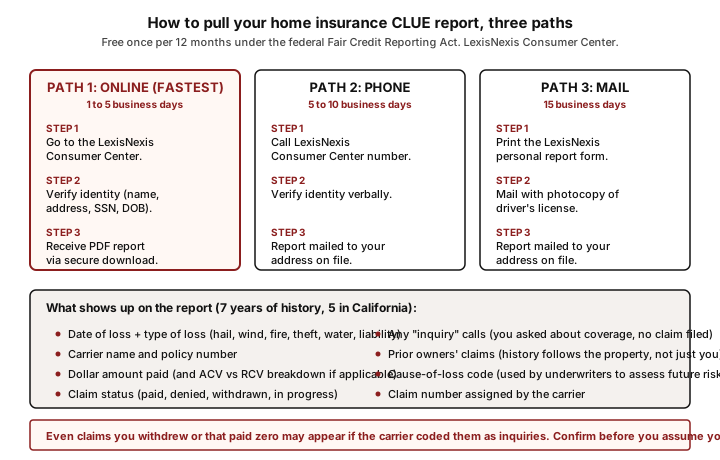
The three paths.
- Online (fastest, 1 to 5 business days): Go to the LexisNexis Consumer Center. Verify identity with name, address, Social Security number, date of birth, and out-of-wallet questions (prior addresses, vehicle, mortgage). Receive the PDF via secure download.
- Phone (5 to 10 business days): Call the LexisNexis Consumer Center. Verbal ID verification. Report mailed to your address on file.
- Mail (15 business days): Print the LexisNexis personal report request form, mail it with a photocopy of your driver’s license to the address on the form. Slowest path, but the most paper-trail-friendly if you anticipate disputing later.
What shows up on the report.
- Date of loss and type of loss (hail, wind, fire, theft, water, liability).
- Carrier name and policy number for each claim.
- Dollar amount paid (and the ACV vs RCV breakdown, if applicable).
- Claim status: paid, denied, withdrawn, in progress.
- Inquiries: any time you (or a prior owner) called the carrier to ask about coverage on a specific incident, even if no claim was opened.
- Prior owners’ claims, since the report is property-keyed as well as person-keyed.
- The cause-of-loss code the underwriter sees.
- Claim number assigned by the carrier.
The inquiry trap. Calling your carrier “just to ask” whether something is covered can get logged as an inquiry on CLUE, which underwriters read the same way as a small denied claim. If you only want to know your coverage, ask your independent agent (not the carrier’s claims line) or read your declarations page yourself.
How to dispute a CLUE error. If a claim on the report is wrong (carrier name, date, amount, or status), file a dispute with LexisNexis through the same Consumer Center, citing the specific line. LexisNexis has 30 days under the FCRA to investigate, contact the carrier, and either correct or confirm the entry. Keep your dispute confirmation number and the response letter.
Done looks like. A printed CLUE report dated within the last 30 days, every line read, and any errors disputed. You now know, factually, what every other carrier sees about your record.
Step 2: Read your declarations page (the deductible is the trap)
The declarations page is the 1 to 4 page summary at the front of your homeowner policy that lists your coverage limits, deductibles, and any exclusions. It is updated every renewal, and the renewal language is where carriers quietly change the deductible structure. From the pre-filing video:
Insurance companies are making changes to the way that they write policies and renew policies and oftentimes that includes raising the deductible amount and oftentimes what they’ll do is they’ll make the deductible amount a percentage of the home value.
Pre-filing contractor video, Watch This BEFORE You File An Insurance Claim For Your Roof!
The video documents two homeowner cases that show the spread:
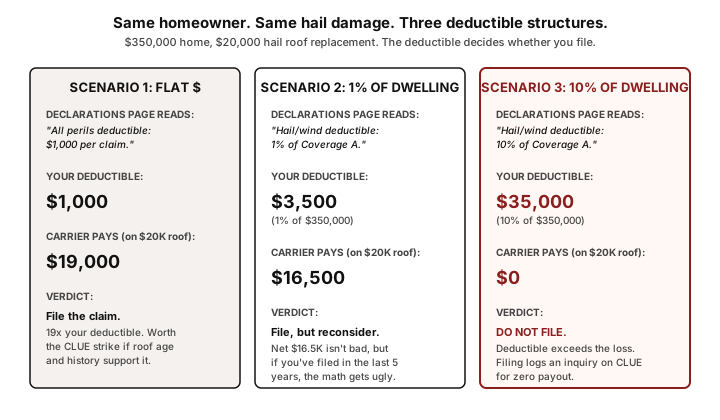
- One homeowner thought she had a $1,000 deductible. At filing, she learned the renewal had moved her to 1% of home value. On a $350,000 home, that is $3,500, three and a half times what she expected. She paid the difference out of pocket.
- A second homeowner had been moved to 10% of home value on the wind/hail peril. The contractor advised against filing. On a $350,000 home, the deductible would have been $35,000, larger than most full roof replacements.
Four things to confirm on the declarations page before you file.
-
Deductible structure. Flat dollar (e.g., “$1,000”) or percentage of Coverage A dwelling limit (e.g., “1% of dwelling” or “2% on hail/wind”). Some policies have a separate, higher deductible for wind, hail, or named storms.
-
ACV vs RCV. Replacement Cost Value pays today’s cost to replace; the depreciation comes back as a second check after you complete the work. Actual Cash Value pays today’s cost minus depreciation, and the depreciation is gone forever. The pre-filing video walks through the math:
If you have actual cash value coverage on your roof then let’s say your roof is 10 years old and it’s a 30-year shingle so then basically there’s 33 percent depreciation on your roof.
Pre-filing contractor video, Watch This BEFORE You File An Insurance Claim For Your Roof!
On an ACV policy with a 13-year-old roof, the same video documented a homeowner getting only 61% of the replacement cost after depreciation, before the deductible came out.
-
Soft-metal exclusions. Some lower-tier policies exclude metal pieces of the roof and house: gutters, downspouts, vents, flashing, AC fins, mailbox. The carrier calls the dents cosmetic and pays nothing on those line items. The pre-filing video documented a homeowner who had to sell her house with damaged gutters and downspouts because the policy excluded them. Read the exclusions section before you file.
-
Filing deadline. Most policies require a hail claim to be filed within 1 year of the date of loss; State Farm allows 2 years. Wisconsin and a handful of other states have a 1-year statute by law, regardless of carrier.
Done looks like. Your declarations page printed, the deductible amount written down in dollars (not percent), the ACV/RCV box highlighted, and the exclusions section read.
Step 3: Get a real estimate (without filing the claim)
Most local roofers will inspect a hail-damaged roof and write a free estimate. The estimate gives you the number you need to compare against your deductible. The estimate is not a claim, and the inspection does not get logged anywhere. Two cautions:
-
Pick a local established roofer, not a door-knocker. Door-knockers and out-of-state storm chasers have a financial incentive to push you to file, even if your roof would not have qualified on the merits. The Chicago State Farm thread is the cautionary tale:
That roofing guy is no friend of yours. He’s an ambulance chaser. If the roof is old and needs replacing, replace it. Insurance isn’t for maintenance, it’s for sudden, catastrophic losses.
u/Username_Used, r/Insurance thread
-
Do not let the roofer file the claim for you. A roofer cannot legally file a claim on your behalf, and any roofer who offers to is a red flag. A r/Insurance commenter on the Chicago thread spelled out what the roofer actually was:
Additionally, that “roofer” isn’t an “adjuster” - don’t fall for that… he’s a sales associate trying to make his commission.
u/VPR2012, r/Insurance thread
What you want from the inspection. A walking estimate of repair-only cost (patch and replace damaged shingles, soft metals, vents) and a separate full-replacement cost. Both numbers in writing. Most local roofers will email a one-page summary the same day or next day.
Done looks like. Two written numbers (repair, replacement) from at least one local roofer, plus your deductible from step 2 in dollars.
Step 4: Estimate the non-renewal risk
This is the math most homeowners skip. The cost of filing a claim is not just the deductible. It also includes:
- The premium increase at next renewal (varies by state and carrier; commonly 10% to 30% on the property line for hail-belt states).
- The probability of non-renewal on the third claim in five years.
- The carrying cost of being marked higher-risk on CLUE for the next 7 years (5 in California), affecting every quote you get for that period.
The 3-claim heuristic, triangulated. No carrier publishes its non-renewal threshold, but the community consensus across multiple Reddit threads, blog posts, and the pre-filing video is consistent. From the Chicago State Farm thread:
You’ve already filed 2 claims. If you file a 3rd, you are almost guaranteed to be non-renewed. The chances of it being covered at this point are slim-to-none, especially if you haven’t repaired the damage from the first 2 hail storms.
u/FindTheOthers623, r/Insurance thread
The pre-filing video corroborates the same threshold from a different angle, with a real case:
I’ll tell you a story about a friend of mine… he’d been with this insurance company for 40 years paying premiums for 40 years with no claims during that 40 years then his son got in an accident with one of his cars so there’s a claim and then his storage unit got broken into there’s another claim and then hail hit his house totaled his roof there’s a third claim all of this happened within a one-year period none of it really his fault… the insurance company called him and told him they were dropping him because he had too many claims.
Pre-filing contractor video, Watch This BEFORE You File An Insurance Claim For Your Roof!
40 years of clean record. Three claims in one year, none his fault, and he was non-renewed. That is the mechanic.
Carrier-by-carrier reputation, from the corpus. Triangulated from r/Roofing and r/Insurance:
| Carrier | Reputation | Source signal |
|---|---|---|
| Travelers | ”Most lenient carrier”; if they deny, the claim is genuinely weak | r/Roofing thread on Travelers partial denial |
| Nationwide | ”One of the easier carriers” in Texas | r/Roofing first-hail-claim Nationwide thread |
| State Farm | Strict on first inspection; community consensus is “doing the deny and the delay” but recoverable with documentation | YouTube #07 (25-year contractor) |
| Allstate | Requires multi-slope test squares and soft-metal corroboration; tight on weak claims | r/Insurance Allstate Texas thread (insider agent comment) |
None of these are official thresholds. The community pattern is consistent: file when the loss is large and clear-cut; fold when it is borderline.
The “inquiry can’t raise rates mid-policy” caveat. A Texas public adjuster on r/homeowners noted that carriers cannot legally raise your rate in the middle of a policy term in response to a single claim. They can, and do, raise it at renewal, and they can, and do, non-renew you at the next renewal date if your record exceeds their underwriting threshold. The protection is narrower than it sounds.
Done looks like. Three numbers written down: the expected payout (repair cost minus deductible), the expected premium increase at next renewal in dollars, and the count of claims already on your CLUE record from the last 5 years.
Step 5: Decide. The decision tree.
Three questions. Any “no” routes you to fold.
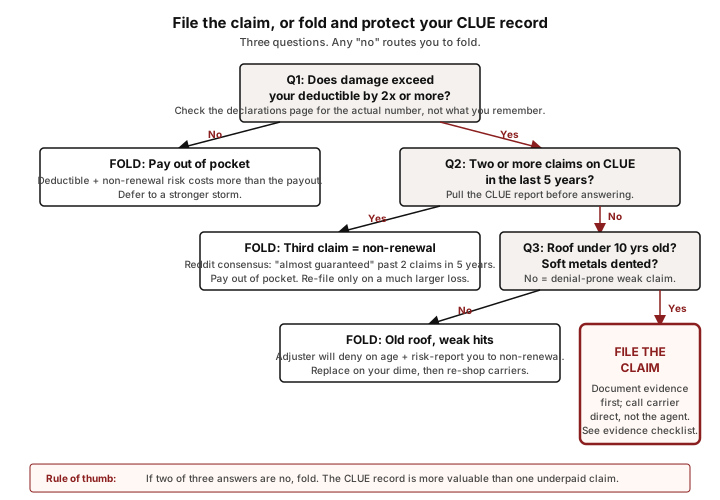
Q1: Does the damage exceed your real deductible by 2x or more?
The 2x rule is conservative. At 1.5x, the carrier’s depreciation and any contested line items often eat the rest, and you walk away with a few hundred dollars in exchange for a CLUE strike. At 2x or more, even an aggressive ACV cut and disputed line items still leave a meaningful payout.
If no: fold. Replace what is damaged on your dime. Defer to a stronger storm, or to the moment the roof is genuinely past its useful life and the insurance question is moot.
Q2: Have you filed two or more claims on this CLUE record in the last 5 years?
Pull the report from step 1 and count. Include any claim coded as a loss, regardless of payout. Inquiries are a softer signal but still count for some underwriters.
If yes: fold. The Chicago State Farm case in Reddit #12 is the documented version. Two prior claims, third claim attempted, non-renewal threatened immediately. The OP’s edit at the end of the post:
I agree with all the comments that the guy screwed me. I am aware that the claims follow me. I need to find an honest person who can tell me if I really need a roof replacement. If not, I’m willing to ride it out until I do actually need a replacement.
u/Illustrious_Year7718, r/Insurance thread
That edit is the right answer for anyone with two prior claims on the record.
Q3: Is the roof under 10 years old, with hail-strike pattern visible on the soft metals?
Roof age and soft-metal corroboration drive the adjuster’s decision. An old roof with weak hail strikes is the carrier’s favorite denial template, and a denial still hits CLUE. Worse, a r/Roofing commenter described the second-order risk:
By making a claim on old roof, you’ve just triggered non-renewal. Insurance now knows it’s damaged and will require replacement or drop coverage.
Paraphrased from r/Insurance wear-and-tear denial thread, file
reddit/06_wind_damage_vs_wear_and_tear_denial.md
If no: fold. Replace the roof on your dime, then re-shop carriers from a clean position with a brand-new roof.
If all three are yes: file. Document the damage first (see the evidence checklist), call the carrier directly (not the agent, who can’t open a claim and may flag your “interest” call), and run the full denial-and-supplemental playbook from the master pillar guide.
When a claim is not worth filing
Five concrete situations where the right answer is to fold and pay out of pocket:
- Damage is below or at your deductible. Even on a flat $1,000 deductible, $900 in soft-metal damage is a CLUE strike for $0 net.
- You have two prior claims on CLUE in the last 5 years. The third claim almost guarantees non-renewal, regardless of how legitimate it is.
- Your roof is over 15 years old on an ACV policy. Depreciation alone will cut the payout below the deductible. The pre-filing video documented a homeowner on an ACV policy with a 13-year-old roof receiving only 61% of the replacement cost; older policies trend worse.
- Your declarations page shows a 5% or higher percentage deductible on hail/wind. On a typical mid-priced home, that puts the deductible above any standard hail roof replacement.
- Your policy has a soft-metal cosmetic exclusion AND the only damage is to soft metals. The carrier owes nothing on the line items the damage actually consists of.
The reframe most homeowners need, also from the Chicago State Farm thread:
Homeowners insurance is to protect against catastrophic loss. Not to get free roofs or perform general maintenance.
u/ReddiGod, r/Insurance thread
That is the underwriting position, and it is the standard you are graded against. The carrier is fine paying a $40,000 tornado claim every 20 years. They will drop you for a $3,000 hail claim every 18 months.
What not to do
- Do not call the claims line “just to ask.” That call gets logged as an inquiry on CLUE and the carrier’s internal risk system. Ask your independent agent or read the declarations page yourself.
- Do not let a roofer file the claim for you. It is illegal in every state, and the roofer has a financial interest in pushing you toward filing even when the math says fold. The Chicago thread is the case study; don’t be it.
- Do not file based on a door-knocker’s free inspection. Door-knockers find damage on every roof they inspect; that is the business model.
- Do not assume your deductible is what it was when you bought the policy. Read the current declarations page. Renewals quietly change deductible structures.
- Do not rely on a verbal “we’ll cover it” from the agent or claims rep before the inspection. Get any commitment in writing or assume it does not exist.
- Do not file a claim and then withdraw it to “undo” it. Withdrawn claims still appear on CLUE as inquiries and still affect underwriting.
Key takeaways
- The CLUE report is a 7-year national record of every claim and inquiry on you and the property; every carrier reads it before quoting or renewing.
- Pull it free once a year from LexisNexis Consumer Center. Online is fastest (1 to 5 business days).
- Read your declarations page. Deductibles have quietly moved from flat dollars to 1% to 10% of dwelling value on many carriers.
- Get a free local roofer inspection (not a door-knocker) for a written repair-vs-replacement number before calling the claims line.
- Three claims in five years is the community-consensus non-renewal threshold across major carriers.
- Decide using the three-question tree: claim 2x deductible, fewer than 2 claims on CLUE, roof under 10 with hail-pattern. Two “no” = fold.
- A withdrawn or zero-pay claim still appears on CLUE as an inquiry. Calling “just to ask” hurts your record.
FAQ
What is a CLUE report?
A CLUE (Comprehensive Loss Underwriting Exchange) report is a national database of insurance claim history maintained by LexisNexis Risk Solutions. It records every claim filed on you and on the property address over the last 7 years (5 in California). Every U.S. property and auto carrier pulls the CLUE record before quoting or renewing a policy. You are entitled to a free copy every 12 months under the federal Fair Credit Reporting Act.
How do I get a CLUE report?
Request it from the LexisNexis Consumer Center, the only authorized consumer source. Online (1 to 5 business days), phone (5 to 10 business days), or mail (15 business days). You verify your identity with name, address, Social Security number, and date of birth. Do not pay third-party “background check” sites; they sell repackaged data at a markup.
Is a free CLUE report really free?
Yes. The Fair Credit Reporting Act guarantees one free copy every 12 months from LexisNexis Risk Solutions. Additional copies in the same 12-month window may have a small fee that varies by state. Disputes are also free.
How many claims before insurance drops you?
The community-consensus threshold across major carriers is 3 claims in 5 years; 2 claims in the same window starts the yellow-flag underwriting review. No carrier publishes the official number. State Farm, Allstate, Liberty Mutual, and Farmers tend to non-renew sooner; Travelers and Nationwide are typically more patient. The pattern is documented across the r/Insurance Chicago State Farm thread and a contractor pre-filing video that walks through a 40-year customer dropped after 3 claims in a single year.
What is on a CLUE report for my home?
Date of loss, type of loss (hail, wind, fire, theft, water, liability), carrier name, policy number, dollar amount paid (with ACV/RCV breakdown), claim status (paid, denied, withdrawn, in progress), the cause-of-loss code the underwriter sees, and any inquiry calls you (or a prior owner) made to the carrier. Prior owners’ claims appear on the property’s record because CLUE is keyed on both the person and the property address.
How do I dispute a CLUE report error?
File a dispute through the LexisNexis Consumer Center, citing the specific line and the correct information. Under the Fair Credit Reporting Act, LexisNexis has 30 days to investigate, contact the original carrier, and either correct or confirm the entry. Keep your dispute confirmation number and the response letter; if the entry is confirmed but you still believe it is wrong, you can submit a 100-word consumer statement that appears alongside the entry on future pulls.
Does filing a claim raise home insurance premiums?
Yes, at the next renewal, even if the claim was paid. The increase varies by state and carrier; in hail-belt states, a hail claim commonly adds 10% to 30% to the property premium for the next 3 to 5 years. The bigger risk is non-renewal at the third claim in five years, which forces you into the high-risk pool with rates 50% to 200% above standard market quotes.
Does a withdrawn claim still show up on CLUE?
Often, yes. Carriers may report a withdrawn claim as an inquiry, which appears on CLUE for the same 7-year period and is read by underwriters as a soft signal of risk. This is why “calling the claims line just to ask” can hurt you even when no claim is opened. If you only want coverage clarification, ask your independent agent or read your declarations page directly.
Can I get a free CLUE report in Florida?
Yes. The federal Fair Credit Reporting Act applies in every state, including Florida. Florida residents can pull a free CLUE report once per 12 months from the LexisNexis Consumer Center, the same as the rest of the country. Florida has additional consumer-protection laws around insurance disputes; check the Department of Financial Services site for state-specific filings.
How long do hail claims stay on a CLUE report?
7 years from the date of loss in most states; 5 years in California. After the retention window expires, the claim drops off the CLUE record and underwriters no longer see it. Claims older than 7 years may still appear in the carrier’s internal records, which can affect renewal decisions even when the CLUE report is clean.
What is the difference between CLUE and LexisNexis?
LexisNexis Risk Solutions is the company. CLUE (Comprehensive Loss Underwriting Exchange) is the property-and-auto claims database it maintains. LexisNexis also runs other databases (motor vehicle records, public records, employment screening); the consumer-facing process for pulling a CLUE report is the same as for any LexisNexis personal report, which is why the request goes through “LexisNexis Consumer Center” rather than a CLUE-branded portal.
Related reading
- hail damage insurance claim denial playbook (master hub)
- Allstate denied my roof claim
- State Farm roof claim denial guide
- hail under 1 inch denial dispute
- invoke the appraisal clause
- public adjuster vs attorney
- Xactimate estimate gap audit
- hail damage evidence checklist
Want a 2-minute pre-filing decision? Build your file-or-fold report by entering your deductible, dwelling coverage, roof age, and CLUE claim count. The report tells you whether to file, fold, or pull a fresh CLUE first, and pre-fills the LexisNexis request form if you need it.