That exact sentence is in your denial letter, and you Googled it because it sounds both authoritative and wrong. It is half of each. A proper hail damage roof inspection looks at three things: the actual hail size at your specific address (not the county-average figure your adjuster quoted), the manufacturer’s impact rating for the shingles on your roof, and whether the impact pattern on your shingles is actually hail (half-moon bruises with embedded granules) or one of the look-alikes (blistering, nail pops, mechanical damage, foot traffic). Here is how to run each check before deciding to push back or walk away.
TL;DR (the four moves, in order)
- Pull the NOAA Storm Events Database record for your exact address and date. Your hail swath may have been larger than the county-average the adjuster cited.
- Match your shingle type to the UL 2218 Class rating: Class 4 for 2-inch hail, Class 3 for 1.75-inch, Class 2 for 1.5-inch, Class 1 for 1.25-inch. If your hail exceeded your shingle’s rated threshold, the denial is overturnable.
- Distinguish real hail impacts (half-moon bruise, embedded granules, mat exposure) from look-alikes (blistering, nail pops, foot traffic).
- Document soft-metal hits on gutters, vents, drip edge, and AC fins as corroborating evidence.
If all four checks line up, push back. If even one fails, dropping the claim is usually the right call; a third weak claim in three to five years triggers non-renewal.
Why this denial template gets used so often
“Hail under 1 inch doesn’t damage shingles” is the most common denial language in the hail-claim space, and it is often correct. A homeowner on r/Roofing posted photos of pea-sized hail and a roofer’s “damage” markings, and the community response was clear:
That is really small hail, unlikely to do damage. The hail shown doesn’t match the size of the damage to the box vents and soft metals. The box vents look older, I would bet that they’re from the last roof. The damages shown in the picture isn’t hail.
u/ProInsureAcademy, r/Roofing thread
Another commenter on the same thread made the blistering call that most homeowners miss:
Yes you’ve got damage to your soft metals, but no real damage to your shingles. That’s blistering, not hail damage. I would close the claim before your black mark on their record gets any larger.
u/Academic-Abroad7684, r/Roofing thread
The honest answer is that “hail under 1 inch” denials are overturnable about a third of the time: when the hail was larger than reported at your specific address, when your shingle fails below 1-inch impact, or when the adjuster misidentified hail as blistering. The other two thirds, the denial holds and a weak supplemental filing risks non-renewal. These four steps decide which one you are in.
Step 1: Pull the NOAA record for your exact address and date
What to do. Open the NOAA Storm Events Database, filter to your state and date of loss, and find the closest reported hail stone to your address. Save the record with the reported stone size and event time.
Why this matters. The adjuster quoted “the area” hail size. “The area” is a county. Hail swaths are typically 2 to 10 miles wide; your address may have caught 1.5-inch stones while the county-average NWS report logged 0.75-inch. Per Insurance Claim Recovery Support’s public-adjuster guide:
Resources like NOAA’s Storm Events Database can provide specific details about hail size, duration, and wind speeds in your exact location. This can counter claims that no significant hailstorm occurred or that the hail wasn’t large enough to cause damage.
Per Insurance Claim Recovery Support, a national public adjuster firm
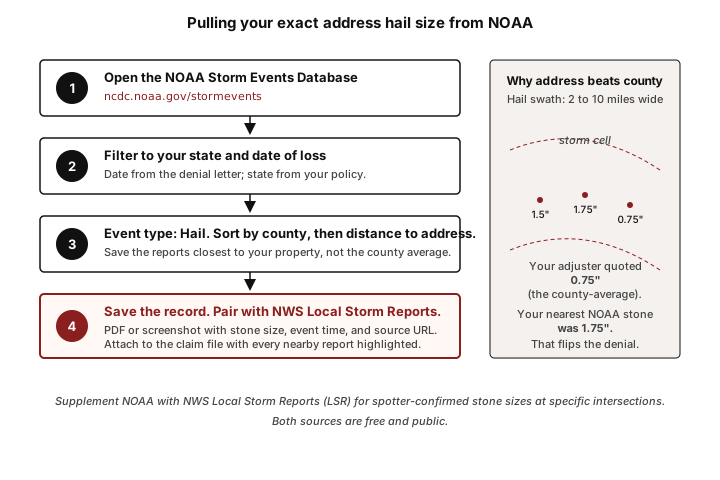
Document every hail report within 10 miles. Your property’s hail size is often closer to the largest reported stone inside the cell, not the county average. If the nearest reported stone was 1.5 inches and the adjuster cited “under 1 inch,” the adjuster used the wrong number.
Pair NOAA with NWS Local Storm Reports. The National Weather Service issues Local Storm Reports (LSRs) during severe events, sometimes at specific intersections. Both are free and public. Pull both for your storm date.
Done looks like. A PDF with the storm date, time, reported stone sizes, and source URLs, with every nearby report highlighted on a map.
Step 2: Match your shingle type to UL 2218 Class rating
What UL 2218 is. UL 2218 is the industry impact-resistance test for roof coverings. Testers drop steel balls of escalating size on the shingle and rate failure against a visible crack or mat exposure:
- Class 1: 1.25-inch steel ball.
- Class 2: 1.5-inch.
- Class 3: 1.75-inch.
- Class 4: 2-inch.
Most architectural laminate shingles are not Class 4 unless you paid for the upgrade; most basic 3-tab shingles are Class 1 or 2. If your roof has standard 3-tab and your NOAA record shows 1.5-inch hail, the impact exceeded the shingle’s rated threshold.
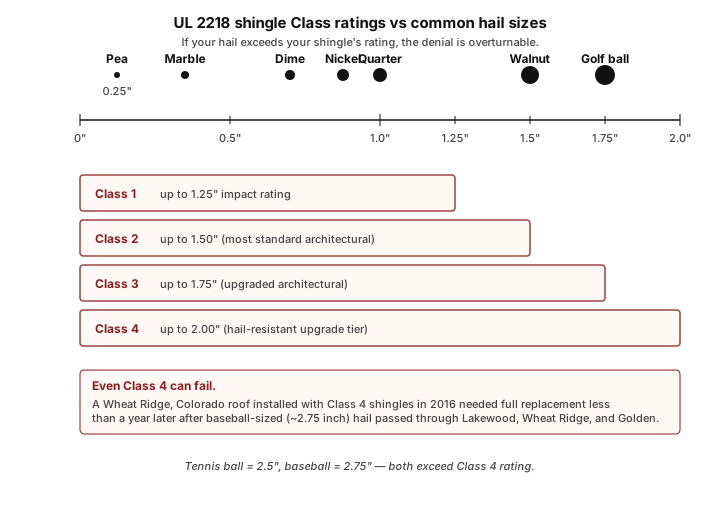
Class 4 is not invincible. A documented Denver case installed Class 4 shingles in 2016 and had them destroyed in 2017 when baseball-sized hail (~2.75 inches) passed through Lakewood, Wheat Ridge, and Golden, per Metro City Roofing’s field history. Class 4 is rated for 2 inches; baseball is bigger.
How to find your shingle rating. Check your inspection report from when you bought the house, look at the shingle wrapper in the garage, or get a local roofer to identify make and model on a 30-minute walk-through. GAF, Owens Corning, CertainTeed, Tamko, Malarkey, and IKO all publish Class ratings by product. Ask specifically whether your shingle carries the UL 2218 Class 4 designation.
Shingle warranties usually exclude hail. Every major manufacturer carves hail out of the standard warranty. That is not relevant to your insurance claim; hail coverage comes from the homeowner policy, not the shingle warranty. The point of citing the UL class is the impact threshold, not the warranty.
Done looks like. Your shingle make, model, and UL 2218 Class rating confirmed in writing, paired with the NOAA hail size for your address. If NOAA exceeds the rated threshold, you have a strong case.
Step 3: Distinguish real hail damage from the look-alikes
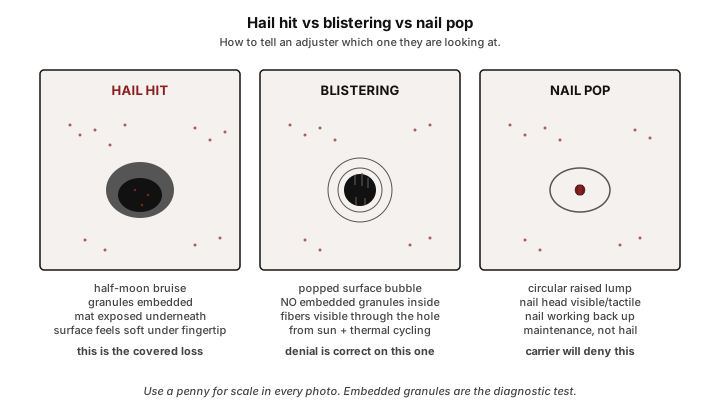
What hail damage actually looks like. A real hail impact leaves a circular bruise with three features: a half-moon depression in the shingle mat, granules embedded into the shingle (not swept off), and the black asphalt mat exposed under the impact. You can feel the bruise with your fingertip; the surface is softer and slightly deformed.
The three most-common look-alikes.
- Blistering. Sun heats the shingle, trapped moisture or gas pops a surface bubble, the bubble tears open. The mark is round like a hail bruise, but blisters have no embedded granules; you see bare asphalt fibers poking through the hole. An r/Roofing regular: “That’s blistering, not hail damage.” Once an adjuster calls it blistering, the claim ends.
- Nail pops. A nail working its way back up raises a circular lump that looks like a hail hit from a distance. The tell is the nail head itself, visible or tactile under the lump. Maintenance, not hail.
- Mechanical damage. Foot traffic, fallen limbs, or a tree branch dragged across a slope leave scrapes and gouges. Hail coverage does not pay for it. If the adjuster finds the pattern along a walk path to your satellite dish, you lose.
The risk-report warning. Presenting lookalikes as hail flags you internally at the carrier:
With the condition of your roof, you run a pretty big risk filing a roof claim. The adjuster could have risk reported you, basically forcing you to replace your roof out of pocket or they’ll drop you. I’d say you got lucky here. [Wait] for a legitimate hail storm that leaves behind good evidence (sizeable spatter and collateral damage).
u/madmardigan23, r/Roofing thread
Storm-chaser red flag. On the same thread, a roofer admitting he games the system: “I get these approved all day, whether or not this is actual hail damage is another thing entirely.” If your roofer sounds like that, the claim ends in a denial or risk report.
Done looks like. Close-up photos of at least three impact marks with visible granule embedment and mat exposure, plus your roofer’s written identification distinguishing them from blistering and nail pops.
Step 4: Document soft-metal hits as corroborating evidence
What soft-metal damage proves. Hail hits soft metal cleanly: round, symmetrical dents with sharp edges. Gutters, vents, drip edge, downspouts, AC condenser fins, window screens, metal lawn furniture, and mailboxes all hold hail impacts visibly. If the adjuster says “hail under 1 inch doesn’t damage shingles” but the same storm damaged your gutters and AC fins, that is a contradiction the carrier has to explain.
An r/Roofing regular on the soft-metal list:
Soft metal is exactly that kind of stuff, vents, roof jacks, flashing, gutters, downspouts, drip edge, window screens, and even things like the mailbox or AC fins if they got peppered. Those pieces usually show clean hits and it helps support that the storm was real even if the shingle debate turns into a fight.
u/AlonzoFinds, r/Roofing thread
Soft metals alone do not win the shingle dispute. They tell you the storm was real and that hail reached your yard. They do not prove the shingles were damaged. If shingles show only blistering, soft metals get you a gutter and vent replacement, not a roof.
What to photograph. Wide shots of each item in context, close-ups with a coin for scale, and matching hits on the mailbox and metal lawn furniture to prove hail was in the yard. Pair with NOAA.
Age matters. Adjusters push back with “those metals are older than the roof”:
Those soft metals are older than your roof. Likely reused metals that have been damaged for over a decade.
u/nescko, r/Roofing thread
Weathered oxidation under the dents means the dents predate the storm. Fresh metal with fresh dents strengthens your case; oxidized metal does not.
Done looks like. A labeled folder with soft-metal photos, a NOAA hail size that exceeds your shingle’s UL 2218 Class rating, close-up shingle photos with granule embedment (not blistering), and a written roofer identification of the impacts as hail.
When the denial is probably correct
Walking away from a bad claim is often the right answer. The Reddit community’s consensus on the original “hail under 1 inch” thread was clear: pea-sized hail on an aging roof with blistered shingles is not a covered loss, and filing the claim anyway puts a mark on your CLUE report.
Signs your denial is likely correct:
- The NOAA record for your address and date confirms the largest reported stone was under 1 inch.
- Your shingles show blistering (fibers exposed, no granule embedment), not impact bruises.
- Your soft metals are aged (weathered oxidation under the dents) rather than showing fresh hits.
- Your roof is near the end of its life (15+ years on a 20-year 3-tab, or 18+ years on an architectural).
- The only documentation you have came from a door-knocker roofer after the storm.
If three of those five are true, drop the claim. Preserve your non-renewal buffer for the next storm. The master pillar playbook covers the non-renewal math and the 3-claim rule that makes this the right call.
Common variants of this denial and the counter for each
- “The reported hail size in your area was below 1 inch.” Pull the NOAA Storm Events record for your address. The reported size for your address may be different from the area average.
- “Your shingles show blistering, not hail damage.” Show close-up photos with embedded granules and exposed mat. If the mark has no granules and exposed fibers, the adjuster is right.
- “Those soft-metal dents are older than your roof.” Show oxidation or absence of oxidation under the dents. Fresh metal with fresh dents is the strongest rebuttal.
- “Hail of this size does not damage Class 4 shingles.” Confirm in writing what shingle is actually on your roof. If it is Class 2 or Class 3, the threshold is lower. If it is Class 4 and your hail was under 2 inches, the denial usually holds.
- “No collateral damage observed in the yard.” Photograph the mailbox, metal lawn furniture, trash cans, and any vehicle that was parked outside during the storm. Matching dents on multiple soft-metal surfaces confirm hail was in the yard.
Mistakes to avoid
- Do not file a supplemental claim on pea-sized hail. If the NOAA record and your photos both show a storm that was genuinely small, a supplemental filing triggers another claim record, not a reversal.
- Do not let a door-knocker roofer mark your roof. Contractor-applied chalk marks or pen dots on look-alike damage are a fraud flag, and an adjuster will see through them in 60 seconds.
- Do not cite the NWS area report as your evidence. NWS reports county-level; your carrier already has that. NOAA Storm Events Database and NWS Local Storm Reports are the address-specific sources.
- Do not pretend blistering is hail. You will be told the roof equivalent of “get bent,” and the claim closes with a risk report on file.
- Do not miss your appeal window if the NOAA check actually supports your case. Most policies give 30 to 180 days from the denial to file a formal appeal.
Key takeaways
- “Hail under 1 inch doesn’t damage shingles” is a real denial template, and about a third of the time it can be reversed by pulling the address-level NOAA record.
- UL 2218 Class 4 shingles are rated for 2-inch hail; Class 3 for 1.75 inches; Class 2 for 1.5 inches; Class 1 for 1.25 inches. Your shingle’s Class decides whether the hail size was enough to fail the roof.
- Hail impacts leave half-moon bruises with embedded granules; blistering exposes fibers without granule embedment; nail pops show a nail head under the mark.
- Soft-metal damage proves the storm was real in your yard. It does not prove the shingles were damaged.
- If NOAA, your shingle Class, your impact photos, and your soft metals all support you, dispute. If they do not, walk away and preserve your non-renewal buffer.
FAQ
How do I dispute a hail under 1 inch claim denial?
Pull the NOAA Storm Events Database record for your exact address and date, confirm your shingle’s UL 2218 Class rating, photograph real hail impacts (half-moon bruises with embedded granules, not blisters), and document hits on gutters, vents, drip edge, and AC fins. If your hail size exceeded the shingle’s rated threshold with impact photos plus soft-metal corroboration, submit a written appeal within your policy’s appeal window.
What does hail damage look like on a roof?
A real hail impact leaves a circular half-moon bruise with granules embedded into the mat and the black asphalt exposed underneath. You can feel the bruise with your fingertip; the surface is softer and slightly deformed. Look-alikes: blisters (no granules, fibers exposed), nail pops (nail head visible), and mechanical scrapes from foot traffic.
Is roof blistering the same as hail damage?
No. Blistering happens when the sun heats a shingle, trapped moisture or gas pops a surface bubble, and the bubble tears open. The mark looks circular like a hail hit, but there are no embedded granules inside; you see bare asphalt fibers instead. Adjusters deny claims on blistering, and community roofers agree it is not a covered loss.
How do I pull NOAA hail data for my address?
Open NOAA Storm Events Database at ncdc.noaa.gov/stormevents, filter by state and date of loss, set the event type to Hail, and sort by location to find stones closest to your address. Save the record page with reported stone size, event time, and source URL. Pair it with NWS Local Storm Reports for spotter-confirmed sizes.
What is UL 2218 Class 4 shingle rating?
UL 2218 is the industry impact-resistance standard for roof coverings. Testers drop steel balls of escalating size and rate failure by crack or mat exposure. Class 1 at 1.25 inches, Class 2 at 1.5, Class 3 at 1.75, Class 4 at 2 inches. Most architectural shingles are Class 2 or 3; Class 4 is the hail-resistant upgrade.
What size hail causes shingle damage?
Standard 3-tab shingles often show visible damage at 1-inch (quarter-sized) hail. Architectural laminate shingles typically resist up to 1.5 inches (walnut-sized). Class 4 shingles are tested for 2-inch (tennis-ball) hail but can still fail on 2.75-inch (baseball) hail, per a Denver 2017 case. Your shingle’s UL 2218 Class sets the threshold.
Can I fight a hail under 1 inch denial if my soft metals are damaged?
Soft-metal hits prove hail was in your yard but do not prove shingle damage. If NOAA shows stones over 1 inch and your shingles show granule-embedded impacts, the soft metals corroborate. If your shingles show only blistering, the soft metals support a gutter replacement but not a full roof.
What is cosmetic hail damage, and is it covered?
Cosmetic hail damage marks the shingle surface without affecting waterproofing or structure. Some policies now include a cosmetic damage exclusion that carves these out of coverage, most often on soft metals. Minnesota and Iowa “matching” case law sometimes forces full replacement even when damage is classified as cosmetic; most other states enforce the exclusion.
How do I know if my roof has hail damage vs wear and tear?
Hail damage is random, directional with the storm, and leaves circular bruises with embedded granules and exposed mat. Wear and tear is uniform, with granule loss in the gutters, curled or cracked shingle edges from UV and thermal cycling, and no pattern tied to a specific storm date. An experienced roofer distinguishes the two on a 30-minute walk-through.
Should I get a second opinion if State Farm or Allstate denied under 1 inch?
Yes, if NOAA shows stones larger than reported in the letter, or if your shingles show clear granule-embedded impacts. State Farm’s internal threshold is 4 to 5 hits per 10 by 10 test square; Allstate requires 6 to 8 hits on 3 to 4 slopes. Neither publishes the rule. The State Farm roof claim denial guide and Allstate denied my roof claim playbook cover the carrier-specific rebuttals.
When should I drop a weak hail claim vs fight it?
Drop if NOAA confirms stones under 1 inch, shingles show blistering instead of impact bruises, and the soft metals look aged. Fight if NOAA shows stones above your shingle’s UL 2218 Class threshold, impacts show embedded granules, and soft metals show fresh matching dents. A third weak claim in three to five years triggers non-renewal; preserve the buffer.
Related reading
- hail damage insurance claim denial playbook (master hub)
- hail damage evidence checklist
- Allstate denied my roof claim
- State Farm roof claim denial guide
- how to invoke the appraisal clause
- Xactimate estimate gap audit
- CLUE report and non-renewal risk
Running the verification before you push back on the denial? Generate a free address-specific hail report with your NOAA hail size, your shingle Class lookup, and the soft-metal photo checklist, in 2 minutes.